Category: Small Business

Site Selection: Key Elements in Finding the Right Commercial Space

Brands include Church's Chicken, Costco, Bloomin' Brands, Jersey Mikes, Dillard's, Five Below, HomeGoods, TJ Maxx, and Marshalls.

By Brooke Miller

You know the old saying: “Location. Location. Location.” In the commercial real estate game, well-designed business plans, solid funding, and meticulous execution are all necessary pieces of the puzzle, but without the right location, success can be elusive. Finding the right commercial space for your business plays a pivotal role in determining its fate. The perfect location can be the catalyst for exponential growth, while a poor choice can lead to stagnant sales and missed opportunities. When it comes to selecting the right site, making an informed decision is paramount.

The site selection process involves a thorough evaluation of numerous factors to identify the most optimal location for a particular commercial use, be it a retail store, restaurant, office building, or industrial facility. Engaging the services of a trusted commercial real estate firm that is familiar with the local market can prove to be a prudent choice, as it can streamline the process and will likely yield potential cost and time savings. To kickstart the site selection journey, the first crucial step involves defining the project’s unique requirements and clear-cut objectives. This encompasses determining the ideal property size, type, location, budget, and project timeline. Armed with this comprehensive information, a commercial real estate agent can get to work to find options that make the most sense for a client.

Factors to Consider in the Site Selection Process:
  • Suitability: A site’s prime suitability almost always revolves around its accessibility to customers, employees, and suppliers. A strategic location near major roads, highways, and public transportation can be crucial. Additionally, the availability of utilities to the site as well as environmental considerations can often play a vital role in evaluating suitability. And of course, understanding the site’s zoning is essential, as it determines the permissible uses in the area. If zoning adjustments are needed to align with the intended use, an experienced commercial real estate agent can help navigate municipal requirements for a smooth process.
  • Demographics: A comprehensive evaluation of the surrounding area’s demographic profile is also imperative to ensure it supports the intended use of the property and aligns with the needs of the community and workforce in the area.
  • Market Conditions: Thorough analysis of real estate market conditions helps gauge the demand for properties or businesses similar to the one under consideration. This information is vital for predicting the potential return on investment. An in-depth market analysis includes studying current trends, the availability of land or commercial spaces in the desired location, traffic counts, and property values.
  • Competition: The presence of similar businesses or developments in the area also should be evaluated to determine the expected level of competition and the potential for market saturation.

Once potential sites have been selected, a tour of each site usually follows to help investors determine the best possible option.

How Kelley Commercial Partners Can Help

Over the years, we’ve helped numerous major brands and businesses navigate the complexities of site selection, so if you’re looking to embark on a successful commercial venture, Kelley Commercial Partners’ team of knowledgeable agents possesses the expertise to guide you through every step of the process. We understand that “location” is the cornerstone of prosperity, and our thorough evaluation process ensures we find the most optimal site tailored to your unique business needs. With a keen eye on suitability, demographics, market conditions, and competition, we meticulously identify prime locations that can serve as catalysts for exponential growth. You can trust KCP to provide unwavering support in achieving all of your business goals.



Kelley Commercial Partners has an award-winning team of real estate professionals with the experience and knowledge to ensure you maximize your potential and reach your financial goals. Let us help you create a clear plan and provide the guidance you need to confidently move forward. Contact us today or click here to explore available properties.



Tenant Estoppel Certificates

Are you a tenant? A landlord thinking about selling? Or an investor looking to buy a leased property? If you have answered “yes” to any of these questions, it is important that you understand what a tenant estoppel certificate is and the benefits and protections it offers.

What is a tenant estoppel certificate?

A tenant estoppel certificate is a legally binding document signed by a tenant verifying the current status and terms of a lease and specifying any modifications to the original agreement, defaults by the landlord, or other issues relating to the lease. Typically, an estoppel certificate is requested by the landlord as part of the due diligence process before closing on the sale of a property. This statement of facts regarding the lease and the premises estops either party from making a claim that contradicts those facts post transaction.

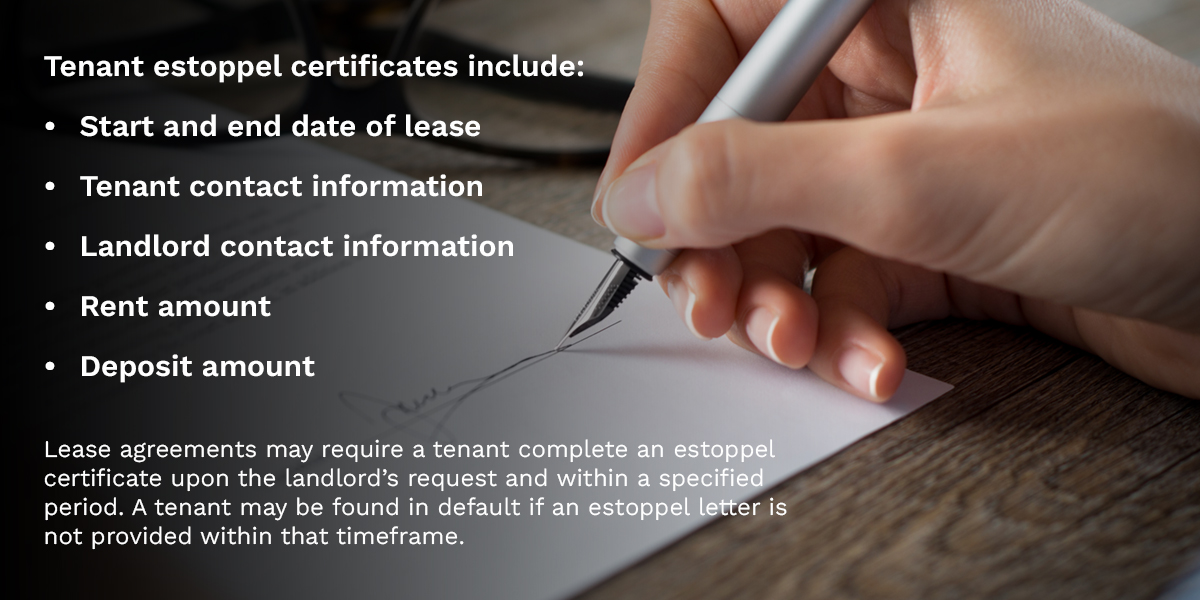
Tenant Estoppel Certificates Include

If you lease, own, or want to purchase a tenant-occupied property, it’s important to understand how a Tenant Estoppel Certificate can protect you.

Most commercial real estate lease agreements include a provision requiring a tenant to complete an estoppel certificate within a specified amount of time after receiving the Landlord’s request. However, only a landlord wishing to sell or refinance the property would request the estoppel. If a lease does not have a provision requiring a tenant to complete an estoppel certificate, it is in the best interest of the tenant to carefully review and complete the estoppel certificate to verify all pertinent lease information.

Why sign a tenant estoppel certificate?

From the tenant’s perspective, an estoppel certificate informs and certifies to the purchaser of the property (i.e., the new landlord under the lease) and, in the event of financing, the lender of any existing issues they will need to address after closing. For lenders and purchasers, the estoppel certificate verifies information presented by the landlord regarding the tenant, the premises, and certain material terms of the lease, which helps prevent any costly surprises after closing.

As a full-service commercial real estate firm, Kelley Commercial Partners provides landlord and tenant representation. And no matter which side we represent, we are committed to successfully guiding you through the process from the beginning through closing. For all your commercial real estate needs, let us be your partner to success.

Kelley Kolettis Designs opens at The Shoppes at Rodney Parham

Kelley Kolettis Designs

Over the last 13 years Kelley Kolettis has progressed from art student, to experienced designer, to successful entrepreneur with her very own design firm, Kelley Kolettis Designs. The Shoppes at Rodney Parham became KKD’s newest home base in February 2022. “We were so pleased to work with such a talented member of the business community and help her find the perfect space for her firm,” said Cheryl White, senior property manager.

Kelley has a wide range of experience working in several different areas of the design world from furniture design, kitchen and bath renovations, commercial office layouts, and event planning, but her current focus and specialization is now on residential design and small commercial projects. Her busiest months are November and December when she is busy decorating homes and businesses around central Arkansas for the holidays.

Shoppes at Rodney Parham

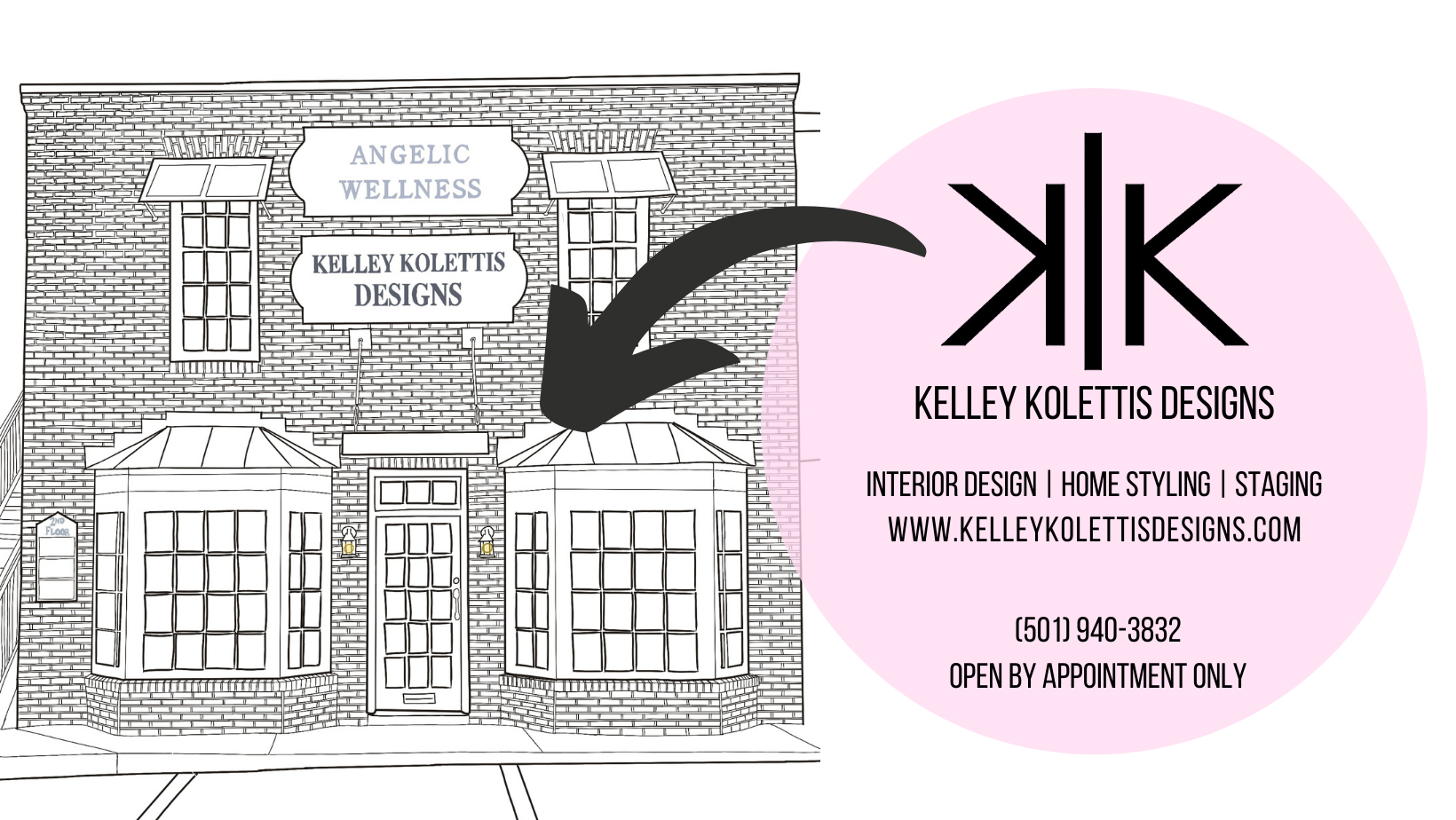
Kelley Kolletis Designs, 10020 N. Rodney Parham, Suite 6, Little Rock. Illustration by Ellen Yahl

Kelley is available by appointment to meet with you at the studio located in Suite 6 of the Shoppes where her unique and sophisticated style are on full display. If you can’t get to her studio, Kelly offers virtual consultations as well. She is eager to share what she’s learned over her many years of experience and is always willing to answer questions or recommend one of her trusted tradesmen to help you get the job done. Her design studio also features a gallery of works by local artists’ if you’re looking for some color to add to your walls.

“We know that Kelley has many years of success in her future, and we wish her all the best on her journey,” said Brooke Miller, agent and partner.

If you’re looking for space for your business to call home, browse our properties or contact one of our trusted agents at 501.375.3200.

Maggie Hogan: Nominee for Arkansas Business CFO of the Year 2021

Maggie Hogan, CFO

At a luncheon to be held on November 3 at the DoubleTree Hotel, Arkansas Business will honor chief financial officers from small private companies, large private companies, nonprofit organizations, public sector organizations, education, banking, and hospitals.

For the past 13 years, Arkansas Business has recognized the men and women navigating these challenging and often behind-the-scenes positions. Kelley Commercial Partners’ Chief Financial Officer, Maggie Hogan, is among the finalists for CFO of the Year in the small private company category. Other finalists in this category include Scott Dendler of Assembled Products Corp. of Rogers, Stuart McLendon of Dyne Hospitality Group of Little Rock, and Scott Rosenberg of Travel Nurse Across America of North Little Rock. Lifetime achievement awards will be presented to Vickie Judy of America’s Car-Mart, Inc. of Rogers and Johnny McCaleb of Simmons First of Pine Bluff.

We salute all the CFOs being honored as well as those yet to be recognized for the essential work and support they provide to their companies. We are especially proud of Maggie Hogan for her leadership and dedication to our firm.

Commercial Real Estate Leases: The Basics

Leases: The Basics


Whether you are a property owner with leasable land or space or an individual looking for space to lease, it’s important to know the basics of the types of leases that are most common in the commercial real estate world.

Gross Lease

In a gross lease (also known as a full-service lease) the tenant pays a flat monthly rate while the landlord remains responsible for all operating costs of the property including taxes, insurance, and maintenance, as well as other expected costs, such as janitorial service. Because landlords must cover all of the property’s operating costs, the rental rate for gross leases is generally higher than for a net lease. In exchange for paying a higher rate, the tenant has the security of a fixed monthly rent payment, minimizing the possibility for variations in their operating costs, making budgeting more predictable and less complicated.

Net Leases

Net leases shift some or all the operating costs associated with a property to the tenants, and tenants are responsible for that cost in addition to their regular rent. There are three types of net leases: single, double, and triple. Tenants with a single net lease are responsible for one of the operating costs associated with the property, generally the property taxes. With a double net (net-net) lease, the tenant assumes the cost of two of the operating costs, generally the property taxes and insurance. With a triple net (NNN) lease, the tenant assumes all of the property’s operating costs, which include taxes, insurance, and all maintenance costs. Lastly, there is a variation of the triple net lease called absolute net lease (also known as a bondable lease). This type of lease relieves the property owner/investor from all financial obligations and risks associated with the property, including taxes, insurance, structural maintenance, and debt liability. All those obligations are passed on to the tenant normally in exchange for a lower base rent.

Benefits of Net Leases

From the landlord’s perspective, entering into a net lease can simplify the management and operation of the property, which can be especially beneficial if they own multiple properties. Furthermore, net lease rates are typically made for longer terms, which gives the landlord the benefit of long and stable income from the property.

Because net lease tenants assume more of the unpredictable costs associated with maintaining the property, their base rent is often at a reduced market rate. This can mean considerable savings in rent over the long term of the lease. While annual rent increases may be built into the lease agreement, they usually remain below the rate one would pay with a gross lease.

Ground Lease

Yet another variation of a net lease is a ground lease. An owner with undeveloped land may enter into a ground lease in which the lessee agrees to incur the cost of developing the property (i.e., construct a building or business on the land) and in exchange, pays only a NNN lease on the land. Ground lease terms are long, generally 50 to 99 years, but when the lease term ends, the ownership of the both the building and the land revert to the owner.

Negotiating a Lease

Before entering into a lease agreement as “lessor” or “lessee”, know your options so that you can benefit the most from the deal. Agents at Kelley Commercial Partners have the knowledge and experience to walk you through the process and negotiate with your best interests in mind.